Thyme
Other plantsThe Fairies’ Bed
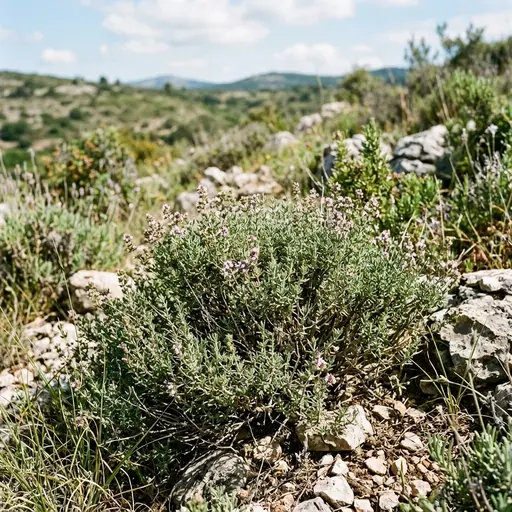
In British folklore, clumps of wild thyme were associated with places frequented by fairies. This belief appears notably in nineteenth-century folklore collections, which describe wild thyme as one of their favorite plants.
Shakespeare had already immortalized this association around 1595 in A Midsummer Night’s Dream. Oberon, king of the fairies, describes the place where Queen Titania sleeps: a bank covered with wild thyme, violets and flowers, where she falls asleep amid the dances of the fairies.
Medicinal properties
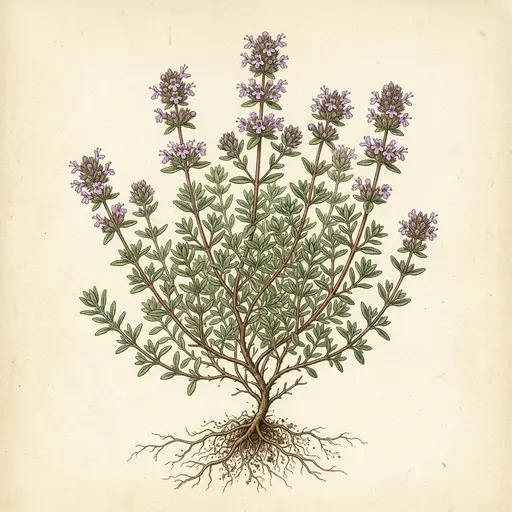
Leaves and flowering tops
Thyme is particularly associated with the respiratory system. Herbalists traditionally use it as an expectorant to help loosen and clear mucus from the bronchial tubes, as well as to calm spasms accompanying a cough. It is notably used for chesty coughs and bronchial congestion.
Recipe
Honey Thyme Syrup
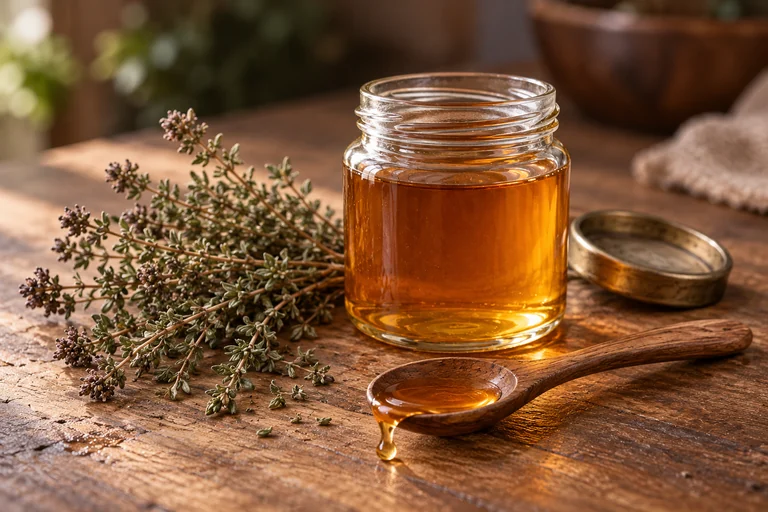
- Plant part
- leaves and flowering tops
- Duration
- 12 hours
Ingredients
- 25 g dried thyme
- 500 ml water
- 250 g honey
Preparation
- Place the thyme in a saucepan and add the water.
- Bring to a gentle boil, then simmer covered for 10 minutes.
- Remove from heat and let steep covered overnight.
- Strain the infusion and measure the resulting liquid.
- Add roughly half the liquid weight in honey.
- Warm gently while stirring until the honey is fully dissolved.
- Pour into a clean container and store in the refrigerator.