St. John's wort
Other plantsThe Herb of St. John
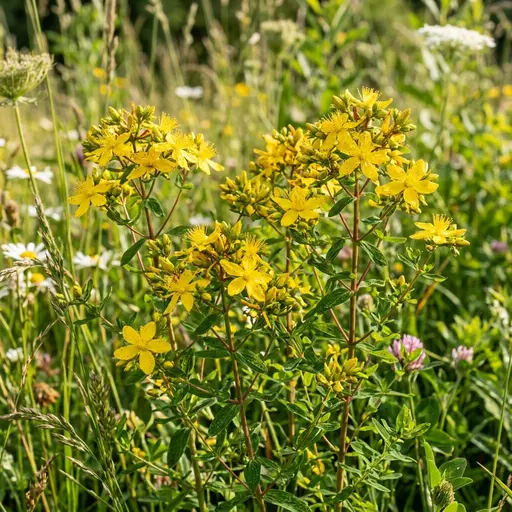
St. John's wort blooms around the summer solstice, when the days are long and the light is almost overwhelming. In European traditions, its yellow flowers were gathered near St. John's Day, then macerated in oil until they turned the oil a deep red.
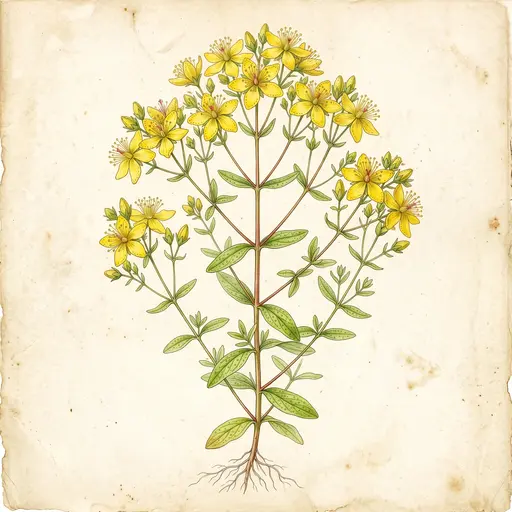
Its French name evokes leaves that look as if they were “pierced by a thousand holes”: when held against the light, tiny translucent glands appear like perforations. This luminous plant holds a special place in herbalism: it is associated with mood, nervousness, and minor skin care. But it is also one of the herbs best known for interacting with medicines, so it calls for much stronger caution than a simple comfort tea.
Medicinal properties
Flowering tops
Traditionally used to help relieve temporary mental exhaustion, mild nervousness, and restlessness associated with difficulty falling asleep.
Standardized flowering top extracts
Some standardized dry extracts are used in herbal medicine for mood balance and mild to moderate depressive symptoms. This use should not be improvised as self-medication because St. John's wort interacts with many medicines.
Flowering tops for external use
In traditional topical use, St. John's wort preparations are associated with minor skin inflammations, such as mild sunburn, and supportive care for small superficial wounds.
Recipe
St. John's Wort Oil Macerate
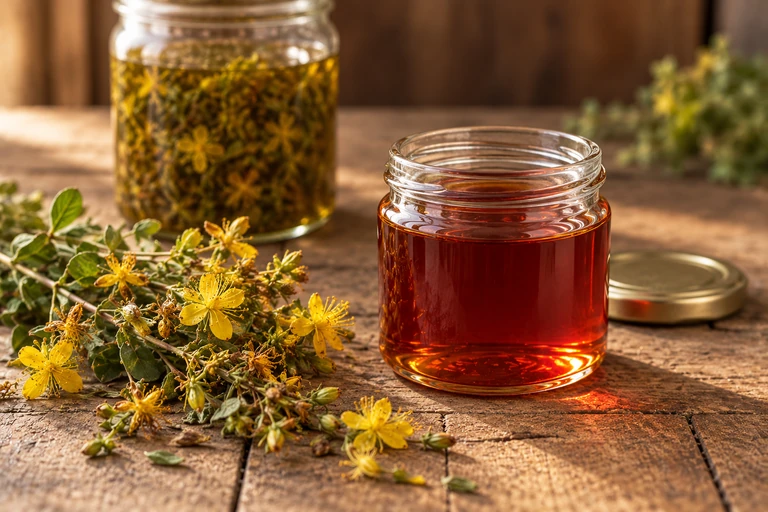
- Plant part
- flowering tops
- Duration
- 3 to 4 weeks
Ingredients
- 25 g St. John's wort flowering tops, dried or fresh and slightly wilted
- 250 ml olive or sunflower oil
Preparation
- Use only a correctly identified plant, harvested in flower and clean.
- If the plant is fresh, let it wilt for a few hours to reduce moisture.
- Place the flowering tops in a clean, dry jar.
- Pour the oil over the plant until it is fully covered.
- Seal the jar and let it macerate for 3 to 4 weeks at room temperature, shaking gently from time to time.
- Strain carefully, then store the oil in a clean, labeled bottle away from light.
Sources and references
- Sedgwick, Icy. St John’s Wort: The Folk Magic of the Midsummer Plant. 22 June 2024. Summer-solstice and Saint John’s Day gathering traditions; John Gerard’s historical red oil made by macerating the plant in olive oil.
- Grieve, M. A Modern Herbal. St. John’s Wort (Hypericum perforatum), 1931. Flowering season, translucent leaf glands visible against the light, traditional nervine use and flowers infused in olive oil.
- European Medicines Agency, HMPC. European Union herbal monograph on Hypericum perforatum L., herba, Revision 1. EMA/HMPC/7695/2021, 23 November 2022. Sections 4.1 and 4.5: traditional relief of temporary mental exhaustion and nervous restlessness with difficulty falling asleep; specified dry extracts for mild to moderate depressive episodes; traditional topical use for minor skin inflammation and minor wounds; medicine interactions. Different indications concern different preparations.
- Merva, Vladka. How to make st john’s wort oil to soothe wounds and burns. SimplyBeyondHerbs, updated 22 December 2021. Fresh flowers wilted for a few hours, or dried flowers; cover with olive oil, macerate in a sunny or warm place for 3–4 weeks, strain, then store in dark bottles. This recipe uses a 250 ml jar and lists 200 ml olive oil; it does not specify 25 g plant material per 250 ml oil or a sunflower-oil variant.