Rose
Other plantsThe Queen of Petals
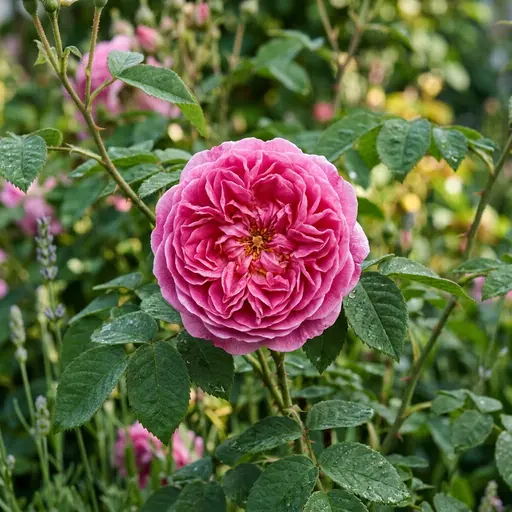
In the gardens of Europe, the Middle East, and Asia, rose has never been only an ornamental flower. It has scented homes, floral waters, sweets, and healing preparations, becoming one of the most symbolic plants in herbalism.
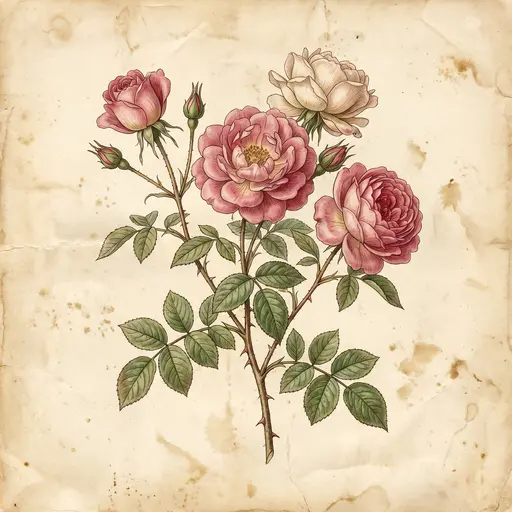
Behind the romantic image lies a very specific plant part: the petal. Classic medicinal roses, such as the apothecary's rose, cabbage rose, or Damask rose, are mainly used for their fragrant, slightly astringent petals. As an infusion, they speak to the mucous membranes of the mouth and throat; as a compress, they bring floral softness to minor skin discomfort. This card therefore focuses mainly on rose petals, not on rose hips, the red fruits of the rose bush.
Medicinal properties
Petals
Traditionally used as a cooled or warm infusion, mouthwash, or gargle to soothe minor inflammations of the mouth and throat.
Petals
Externally, infused petals are traditionally applied as a compress to calm minor skin inflammations.
Petals
Aromatic and slightly astringent, they are also used in herbal teas to add a gentle floral note and subtly accompany digestive comfort.
Recipe
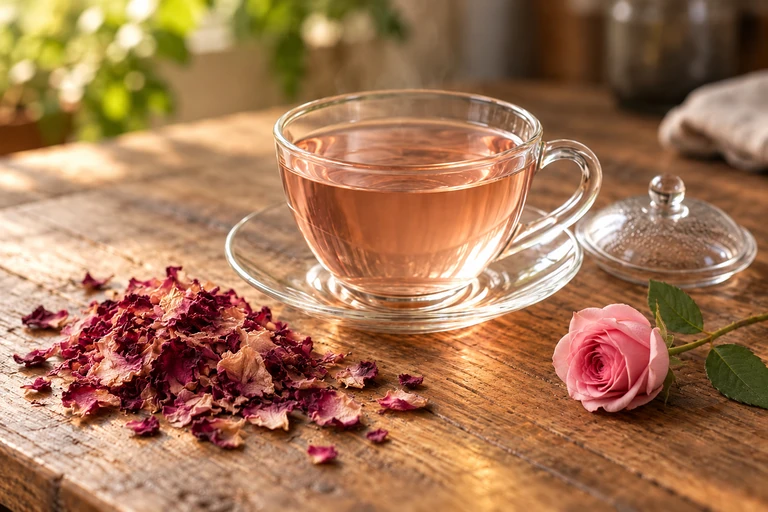
Rose Petal Infusion
- Plant part
- petals
- Duration
- 10 minutes
Ingredients
- 1 to 2 g dried rose petals, food-grade and untreated
- 200 to 250 ml water
- 1 tsp honey, optional
Preparation
- Place the rose petals in a cup or small teapot.
- Pour simmering water over the petals.
- Cover immediately to keep the fragrance in the cup.
- Steep for 10 minutes.
- Strain carefully. Drink warm, or let cool before using as a mouthwash, gargle, or compress.
Sources and references
- Grieve, M. A Modern Herbal. Roses, 1931. Historical cultivation and uses of Rosa gallica, Rosa centifolia and Rosa damascena: perfumery, rose water, confectionery, fragrant and mildly astringent petals.
- European Medicines Agency, HMPC. Assessment report on Rosa gallica L., Rosa centifolia L., Rosa damascena Mill., flos. 1 July 2014. EMA/HMPC/137298/2013. Dried petals: traditional use for mild mouth and throat inflammation and minor skin inflammation. Section 2.1 also records historical digestive uses; digestive comfort is not an adopted EU monograph indication.