Broadleaf Plantain
Other plantsThe Mother of Herbs
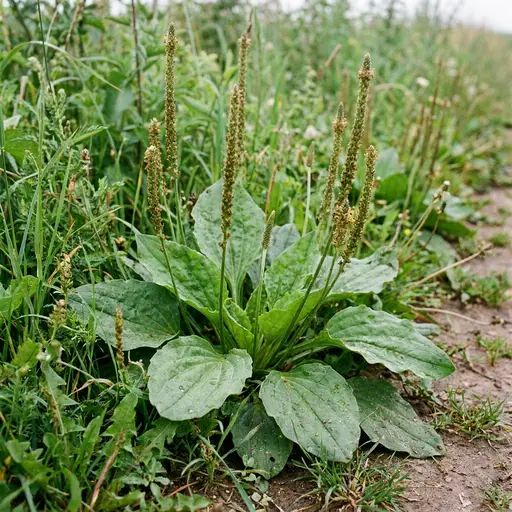
In the old Anglo-Saxon world, plantain did not merely grow on paths: it seemed to travel with them. It was called wegbrade, later waybread, the bread of the road. In the Nine Herbs Charm, an old healing text woven with incantation, it is addressed as the mother of herbs, open to the east and mighty within.
The name suits it well. Plantain endures footsteps, wheels, and doorways; it returns wherever the earth is packed down. Its Asian cousin also carries a road-name, che qian cao, the herb before the cart. In the countryside, people crushed its leaves onto insect stings, nettle burns, and small scrapes. It is a plant almost walked over, yet kept close at hand to mend what the road inflicts.
Medicinal properties
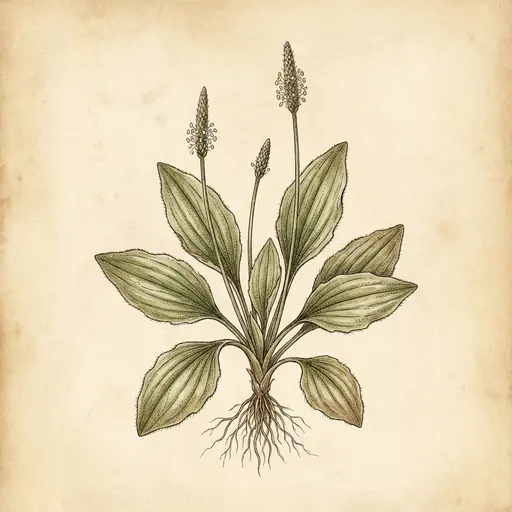
Fresh leaves
Traditionally crushed or bruised into a poultice, the fresh leaves are applied to insect stings, nettle stings, itching, small scrapes, and minor superficial skin irritations.
Leaves
Rich in mucilage and mildly astringent, the leaves are also used as an infusion in herbal traditions to soothe irritated mucous membranes of the throat, mouth, and digestive tract.
Recipe
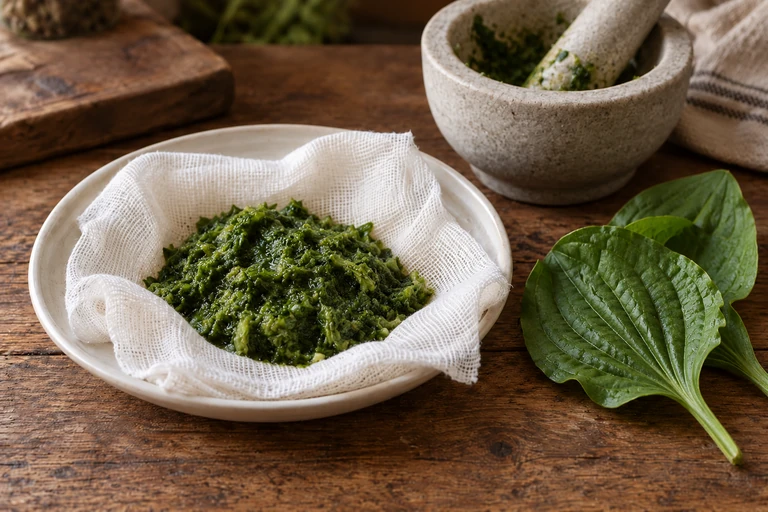
Fresh Plantain Poultice
- Plant part
- fresh leaves
- Duration
- 10 to 20 minutes
Ingredients
- 3 to 5 fresh plantain leaves, clean and correctly identified
- A little clean water, if needed
- A clean compress or cloth, optional
Preparation
- Gather a few leaves from a clean place, away from roads, pesticides, and animal waste.
- Rinse the leaves with clean water and remove any visible dirt.
- Bruise or crush the leaves until they become moist and release their green juice.
- Apply the crushed leaf directly to the irritated, stung, or lightly scraped area.
- Hold it in place with a clean compress or cloth, then leave it on for 10 to 20 minutes.
- Renew with fresh leaves if needed, then gently clean the skin.
Sources and references
- Hostetter, Ophelia Eryn (translation). The Nine Herbs Charm, lines 7–13. Old English Poetry Project, Rutgers University. Waybread as the mother of herbs, open to the east and mighty within.
- Canning, Anna. Woodlands for All, Plantain, pp. 4–5. Forestry and Land Scotland. Pathside growth, trampling, che qian cao and traditional use of crushed leaves on bites, burns and cuts.
- Samuelsen AB. The traditional uses, chemical constituents and biological activities of Plantago major L. A review. Journal of Ethnopharmacology. 2000;71:1–21. doi:10.1016/S0378-8741(00)00212-9. Traditional uses of Plantago major leaves for wounds, insect and nettle stings, skin complaints and oral, throat and digestive complaints; Table 1 and discussion of biological activities. Documentation of traditional uses, distinct from proof of clinical efficacy.
- FitoAlimurgia. Plantain Leaf Bandage: Wilderness First Aid, 18 May 2026. Plantago major: 3–5 fresh leaves, washing, crushing, direct application and optional clean cloth. This article recommends replacing the poultice every 2–4 hours; it does not establish the card’s 10–20-minute application time.