Oat
Other plantsThe Grain That Softens
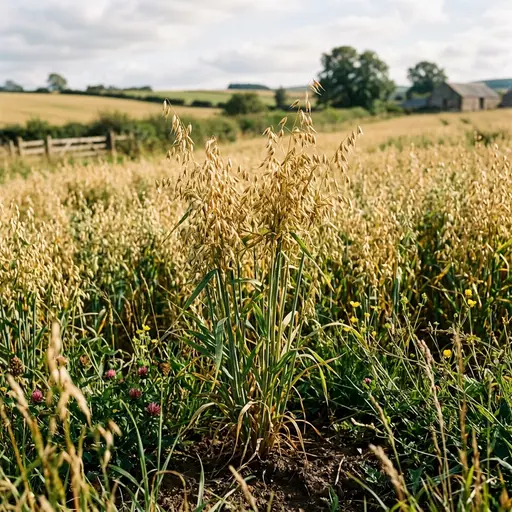
In the cold, damp lands of the North, oat was long the grain of northern peoples. Where wheat asked for too much warmth, oat grew with enough strength to feed homes, horses, and travellers. In Scotland, it became so important that Samuel Johnson mocked it in his dictionary: to him, it was the grain England gave to horses, but Scotland used to support its people. The reply attributed to Lord Elibank turned the joke around: perhaps that was why one found such fine horses and such fine men there.
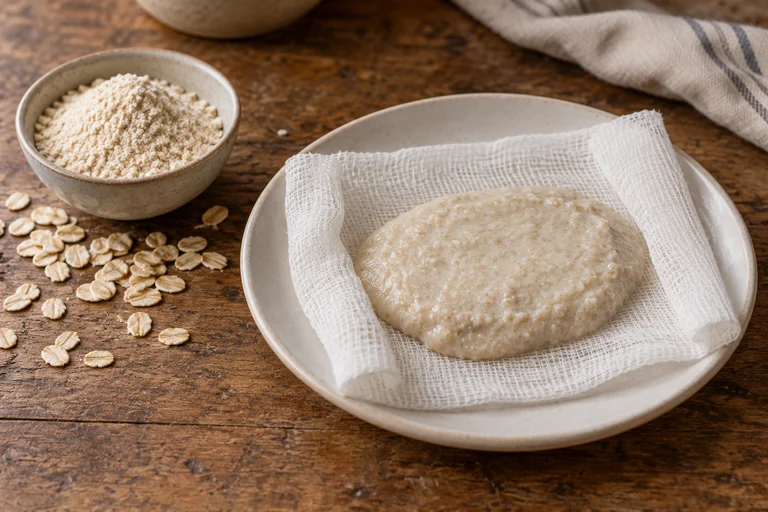
In household herbalism, that same grain sometimes leaves the bowl for the skin: ground into a very fine flour, it mixes with water into a milky paste.
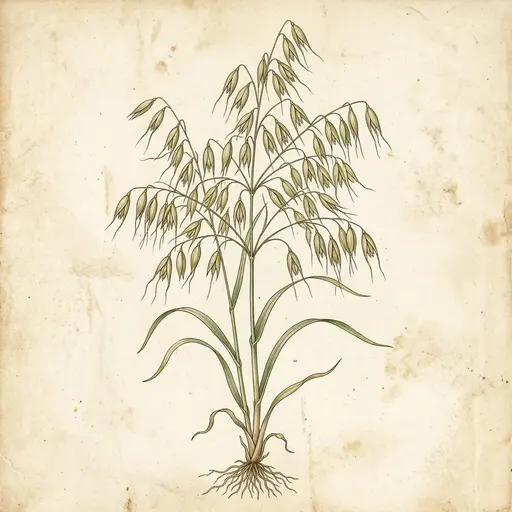
Medicinal properties
Ground grains
Ground into a very fine flour or colloidal oatmeal, the grains are traditionally used as a poultice, compress, or soothing paste for dry, sensitive, irritated, itchy, or mildly eczema-prone skin.
Oat gruel
Prepared as gruel or a thin porridge, oat is also used as a gentle, nourishing, comforting food during periods of weakness, recovery, or mild digestive irritation.
Recipe
Soothing Oat Poultice
- Plant part
- fine oat flakes
- Duration
- 10 minutes
Ingredients
- 20 g fine oat flakes
- 80 to 100 ml water
- A clean compress or soft cotton cloth
- A bowl
Preparation
- Combine the water and oats in the bowl.
- Wait a few minutes for the mixture to thicken into a soft porridge.
- Warm very gently if needed: the mixture should be lukewarm, never hot.
- Spread a thin layer onto the compress and place it on the affected area.
- Leave the poultice on for 10 minutes, then remove it gently and rinse away any residue with lukewarm water, without scratching.
Sources and references
- Scott W. The Letters of Sir Walter Scott. Volume XI, p. 152. Johnson’s definition of oats and the reply attributed to Lord Elibank. Electronic edition, University of Edinburgh.
- Grieve M. A Modern Herbal: Oats (Avena sativa). 1931. Historical uses of oat gruel as food and oatmeal paste as an emollient poultice.
- European Medicines Agency, HMPC. Assessment report on Avena sativa L., herba and Avena sativa L., fructus. EMEA/HMPC/202967/2007. 2008. Oat fruit: traditional cutaneous uses and mucilage for digestive complaints and recovery; distinguish from oat herb.
- Julie V. Cataplasme d’avoine tiède, section recette. Masculin.com. April 10, 2026. 20 g fine oat flakes, 80-100 ml water, thickening for a few minutes, lukewarm application on a compress for 10 minutes, then gentle removal and rinsing.