Common mallow
Other plantsBefore It Was a Colour
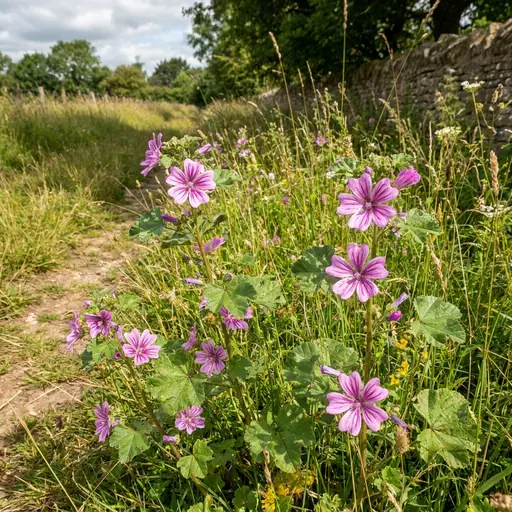
Among the Greeks and Romans, mallow was neither rare nor precious: it belonged to the simple plants that nourished as much as they healed. Horace evoked a frugal table of olives, chicory, and light mallows; Pliny credited it with almost universal virtue. Around the Mediterranean and into the Levant, its leaves remained a country food, the humble khobeiza cooked with garlic, onion, or oil. In herbal practice, this memory is summed up in one gesture: to soften. Leaves and flowers release a gentle mucilage, made for calming what scratches, tightens, burns, or becomes irritated.
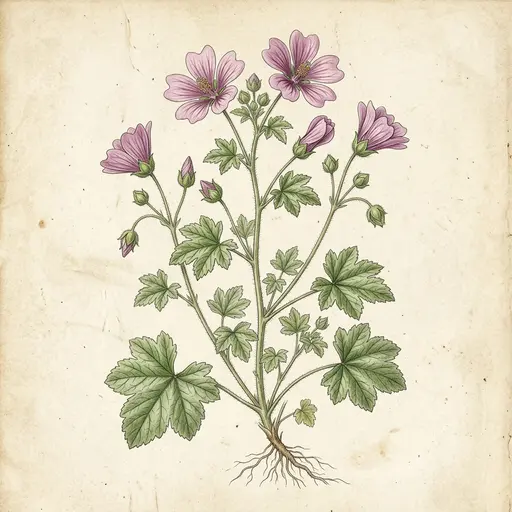
Medicinal properties
Flowers and leaves
Rich in mucilage, they are traditionally used as an infusion to soothe irritated mucous membranes of the throat, mouth, respiratory tract, and digestive tract.
Leaves and flowers for external use
Prepared as a compress, local bath, or poultice, they are traditionally applied to dry, warm, irritated, or mildly uncomfortable skin.
Recipe
Cold Mallow Maceration
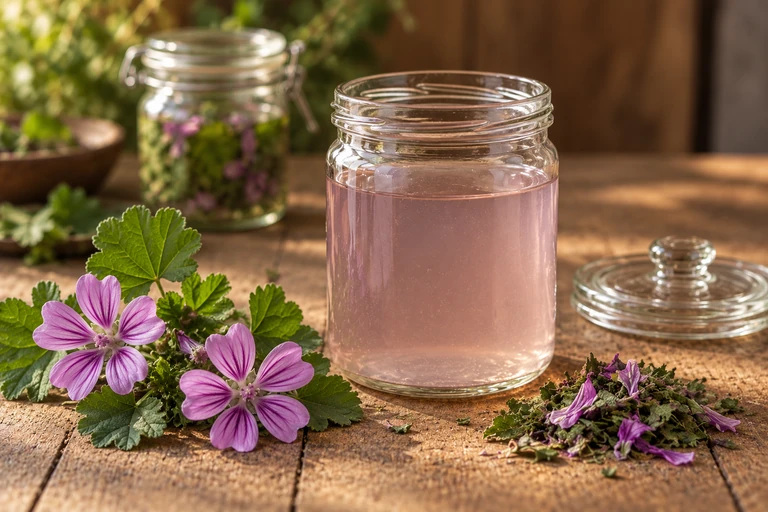
- Plant part
- flowers and leaves
- Duration
- 2 hours
Ingredients
- 20 to 50 g fresh mallow flowers and leaves
- 1.5 L cold water
Preparation
- Finely crush the fresh mallow flowers and leaves or blend them.
- Place the plant material in a clean container and add the cold water.
- Cover and let macerate for 2 hours.
- Strain carefully, pressing the plant material to recover the mucilage-rich liquid.
Sources and references
- Dante. La mauve sylvestre (Malva sylvestris). Books of Dante, 27 March 2020. Historical food and herbal uses among Greeks and Romans, Horace’s olives, chicory and mallows, Pliny’s many attributed uses, and the emollient tradition associated with mucilage.
- Nathan, Joan. King Solomon’s Table: A Culinary Exploration of Jewish Cooking from Around the World. Knopf, 2017. Introduction, Food and Daily Life in Biblical Israel. Wild mallow (khubeiza) among Levantine food plants, combined with onions and garlic in a Mediterranean culinary setting.
- European Medicines Agency, HMPC. Assessment report on Malva sylvestris L. and/or Malva neglecta Wallr., folium and Malva sylvestris L., flos. EMA/HMPC/749518/2016, 20 November 2018. Mucilage and traditional oral/oromucosal uses; historical cutaneous use of leaves and flowers as poultices, lotions and bath additives, pp. 9–12 and 16. The historical cutaneous uses discussed in the report are distinct from the oral/oromucosal indications retained in the EU monographs.
- Zanotti, Eugenio; French translation by Michel Olivié. Malva sylvestris. Monaco Nature Encyclopedia, 22 May 2020. Macération à froid pour des compresses contre les irritations cutanées: crush 20–50 g fresh flowers and leaves, add 150 cl water, macerate for 2 hours, then strain while pressing. Published preparation intended for external compresses.