Licorice
Other plantsThe Root of the Scythian Warriors
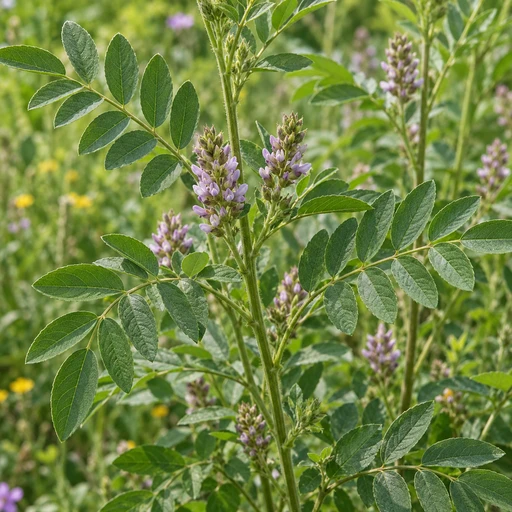
In the fourth century BCE, the Greek philosopher Theophrastus described a remarkable plant he called the ‘Scythian root’. This sweet root, known today as licorice, grew notably near the Sea of Azov, in the territories of the Scythian peoples.
According to Theophrastus, nomadic warriors chewed this root to ease their thirst during long journeys across the steppes. Along with cheese made from mare's milk, it was even said to allow them to go eleven or twelve days without drinking.
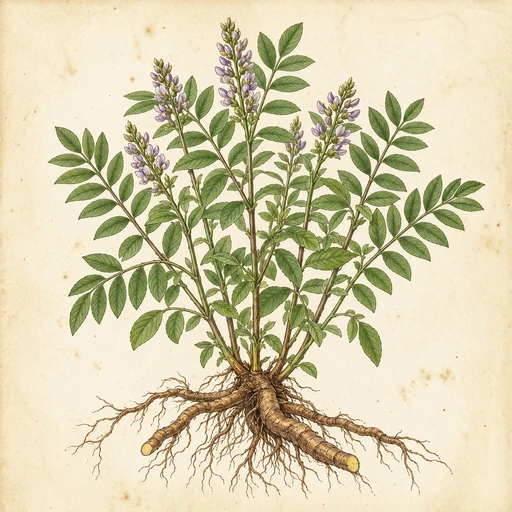
Medicinal properties
Root and rhizome
Respiratory demulcent: traditionally used to soothe irritated mucous membranes in the throat and airways. Its soothing action is particularly valued for easing dry, irritating coughs.
Root and rhizome
Expectorant: rich in saponins, notably glycyrrhizin, licorice is traditionally used to help clear bronchial mucus. It is often combined with thyme in cough preparations.
Root and rhizome
Digestive demulcent: traditionally used to soothe irritation of the stomach lining. Some of its constituents are being studied for their influence on the stomach's protective mucus.
Recipe
Licorice and Thyme Syrup
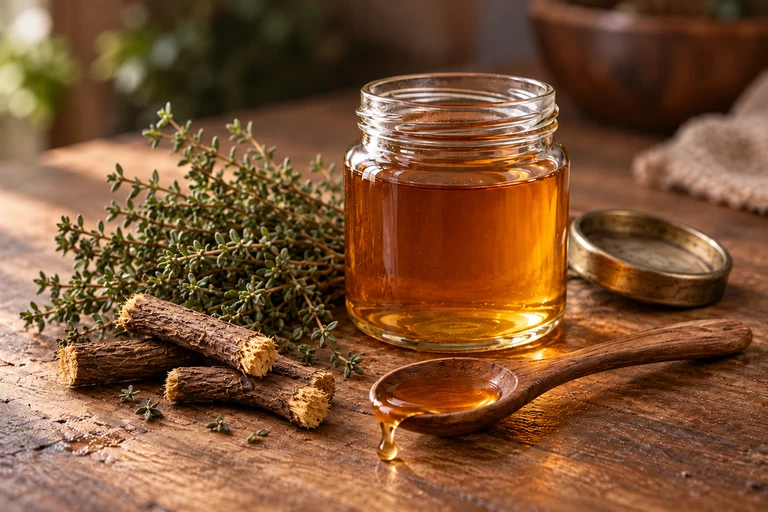
- Plant part
- licorice root and leafy thyme sprigs
- Duration
- About 1 hour of gentle heating, followed by resting overnight
Ingredients
- 500 ml natural honey
- 3 pieces of dried licorice root
- 1 small bunch of fresh thyme
- One clean, airtight glass jar
Preparation
- Cut the licorice root pieces into small fragments to increase their contact with the honey.
- Place the honey, licorice pieces and bunch of thyme in a small saucepan.
- Heat very gently for about one hour, stirring occasionally. Keep the mixture hot without allowing it to reach a vigorous boil.
- Remove the saucepan from the heat, cover and let the herbs infuse in the honey overnight.
- Carefully strain through cheesecloth or a fine sieve to remove the root pieces and thyme sprigs.
- Pour the strained syrup into a clean, dry, airtight jar.
- Label the jar with the preparation name and the date it was made.
Sources and references
- Theophrastus. Enquiry into Plants, Book IX, 13.2. English translation by Arthur Fenton Hort, 1916. ToposText.
- Fiore C, Eisenhut M, Ragazzi E, Zanchin G, Armanini D. A history of the therapeutic use of liquorice in Europe. Journal of Ethnopharmacology. 2005;99(3):317–324. doi:10.1016/j.jep.2005.04.015.
- German Commission E. Liquiritiae radix (Licorice root). Monograph on traditional respiratory and digestive uses.
- American Herbal Products Association. Herbs in History: Licorice.
- European Medicines Agency. Liquiritiae radix — Glycyrrhiza glabra L.; Glycyrrhiza inflata Bat.; Glycyrrhiza uralensis Fisch., radix. European Union herbal monograph, Revision 1. EMA/HMPC/108399/2024.
- The Aromatherapist. DIY Honey, Licorice & Thyme Cough Syrup.
- National Center for Complementary and Integrative Health. Licorice Root: Usefulness and Safety.
- The association between consistent licorice ingestion, hypertension and hypokalaemia: a systematic review and meta-analysis. Journal of Human Hypertension. 2017.