Elder
Other plantsThe Threshold Tree

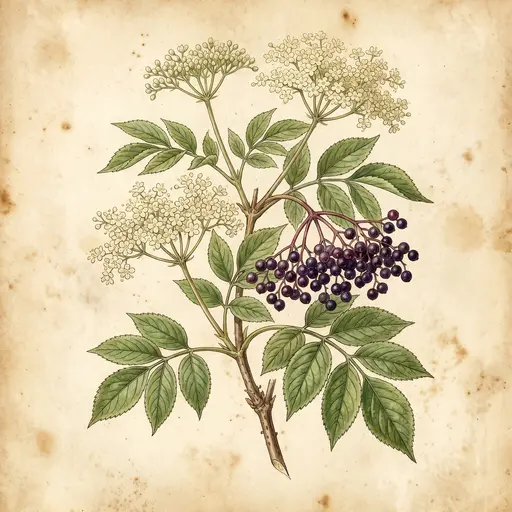
In the hedgerows and woodland edges of Europe, black elder often marks the borders of paths, gardens, and homes. In spring, it bears wide umbels of tiny cream-colored flowers with a honeyed scent; by late summer, they give way to clusters of purple-black berries.
In folk traditions, elder was seen as a household guardian, planted near farms and treated with respect. In herbalism, it is mainly the dried flowers that are prepared as a warm infusion for the first chills of the season; the berries are reserved for cooked preparations, syrups, or compotes, never for improvised raw foraging.
Medicinal properties
Flowers
Traditionally used as a warm infusion to accompany the first signs of a common cold. Elder flowers are associated with a diaphoretic effect, meaning support for gentle sweating during chills.
Flowers
Traditionally used to help relieve some upper respiratory discomforts, such as nasal congestion, irritated throat, mild cough, and mucus, especially in winter herbal teas.
Cooked berries
The ripe berries, always thoroughly cooked, are used in traditional preparations such as syrups and can provide antioxidants. They are also traditionally associated with cold and flu symptoms.
Recipe
Elderflower Infusion
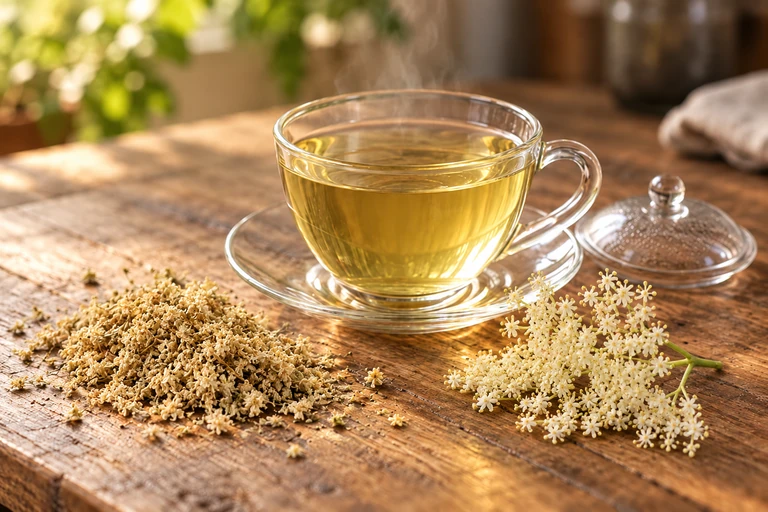
- Plant part
- flowers
- Duration
- 10 minutes
Ingredients
- 2 to 3 g dried elder flowers
- 250 ml water
- 1 tsp honey or a squeeze of lemon, optional
Preparation
- Place the elder flowers in a cup or teapot.
- Pour simmering water over the flowers.
- Cover immediately to keep the aromatic compounds in the cup.
- Steep for 10 minutes.
- Strain, then drink the infusion warm or hot.
Sources and references
- Grieve, M. A Modern Herbal. Elder, 1931. European elder folklore, respect for the elder-tree spirit, protective planting near cottages, protection of houses and livestock, flowers and berries and their traditional household preparations.
- Health Canada. Elder — Sambucus. 19 December 2025. Sambucus nigra subsp. nigra flowers and fruit: traditional cold and flu symptom relief; flowers as a diaphoretic and for nasal congestion, cough, sore throat and catarrh. Fruit: source of antioxidants. Medicinal-effects reference only.