Echinacea
Other plantsThe Prairie Shield Flower
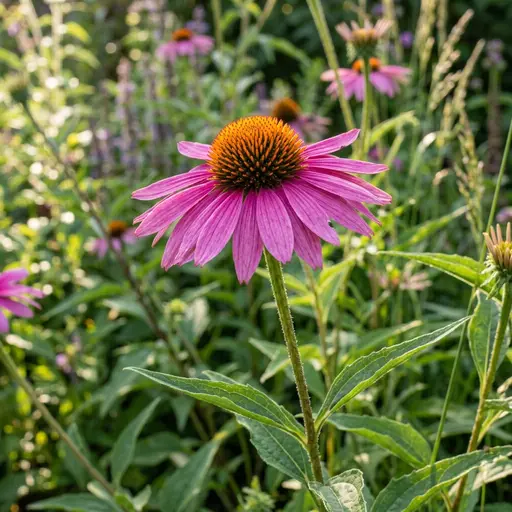
Long before it appeared in European winter teas, echinacea grew across the prairies of North America. Its large purple flower heads, with a spiny central cone like a tiny shield of thorns, gave the plant its name: echinos means “hedgehog” in Greek.
In North American traditions, several echinacea species were used for throat discomfort, colds, and minor skin care. Today, herbalism mainly uses purple coneflower, Echinacea purpurea, whose flowering aerial parts and root are associated with short-term support of the body's natural defenses.
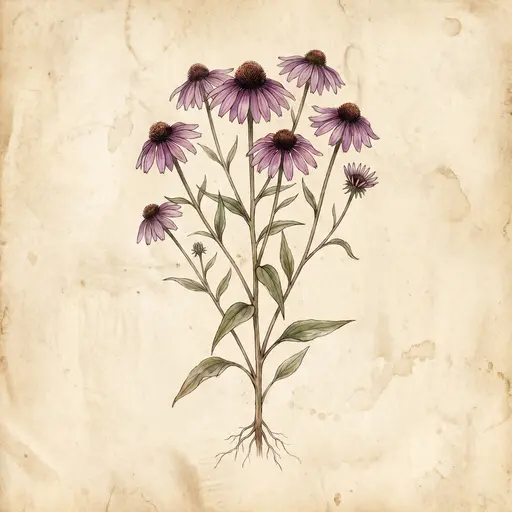
Medicinal properties
Flowering aerial parts
Traditionally used short term to support natural defenses and accompany the first signs of colds or upper respiratory tract infections.
Root
Purple coneflower root is traditionally associated with relieving common cold symptoms when used at the first signs and for a short period of time.
Flowering aerial parts
Externally, some traditional preparations of the aerial parts are associated with minor care for small superficial wounds.
Recipe
Echinacea Root Tincture
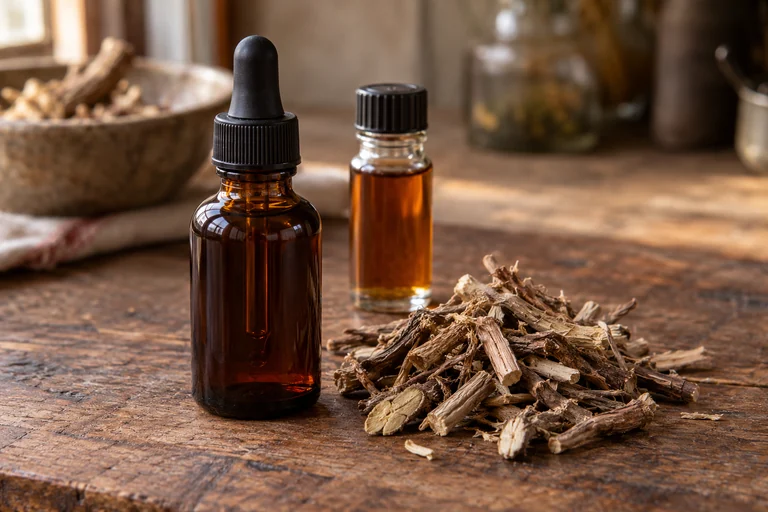
- Plant part
- root
- Duration
- 6 weeks
Ingredients
- 50 g dried, cut purple coneflower root
- 250 ml food-grade alcohol at 45% ABV
Preparation
- Place the dried root in a clean, dry glass jar.
- Pour the alcohol over the root, seal the jar tightly, then label it with the plant, ratio, and date.
- Shake well and leave to macerate for six weeks in a cool, dark place.
- Shake the jar daily during the first week, then every few days for the rest of the maceration.
- Strain through cheesecloth, pressing the root well, then pour the tincture into a clean, labelled dark-glass bottle.
Sources and references
- USDA NRCS, East Texas Plant Materials Center. Eastern Purple Coneflower, Echinacea purpurea (L.) Moench. Plant Fact Sheet. Ethnobotanic uses, North American distribution and Greek echinos etymology.
- German Commission E. Echinacea purpurea herb (Echinaceae purpureae herba), March 2, 1989. Flowering aerial parts: supportive treatment of colds and respiratory infections, immune effects and external wound care. This monograph concerns the aerial parts, not the root.
- EMA/HMPC. Echinaceae purpureae radix: summary for the public, EMA/377966/2017, and European Union herbal monograph EMA/HMPC/424583/2016. Traditional short-term relief of common cold symptoms with specified root preparations. The Commission E root monograph did not recommend therapeutic use on the evidence available in 1992.
- Tara Ruth. How to Make Herb Tincture with Echinacea. LearningHerbs. Dried root at 1:5, six weeks, shaking daily for the first week then every few days, pressing through cheesecloth and bottling. Écart avec la fiche : la recette publiée utilise Echinacea angustifolia et de la vodka à 50 %, plutôt qu’E. purpurea et 45 %. Référence de méthode, pas confirmation intégrale de cette variante.