Common comfrey
Other plantsThe Herb That Knits Together

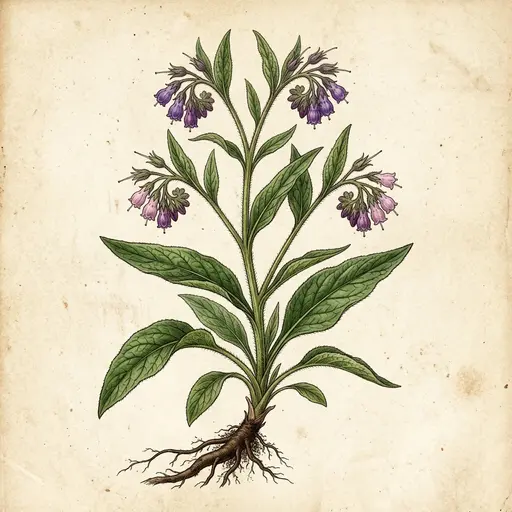
Few plants carry a name as direct as comfrey. In Greek, Symphytum suggests what grows together; in medieval Latin, Consolida already spoke of what is made solid again. In English, it was called knitbone, the herb that knits the bone. In German, Beinwell keeps the same memory: the plant of the limb made whole.
In the old herbals of Europe, its large root, black outside and white and slippery within, seemed almost made for this reputation. It was pounded, sometimes mixed with a little water or fat, then applied to bruises, sprains, and battered limbs.
Medicinal properties
Root
Traditionally pounded or prepared as a poultice, comfrey root is applied to wounds, cuts, ulcers, fractures, sprains, and damaged tissues. Its old name, Consolida, reflects its reputation as the herb that 'knits together' flesh and bone.
Leaves
Fresh leaves are traditionally used as a poultice or compress on bruises, bumps, tired muscles, tender joints, and minor skin irritations.
Recipe
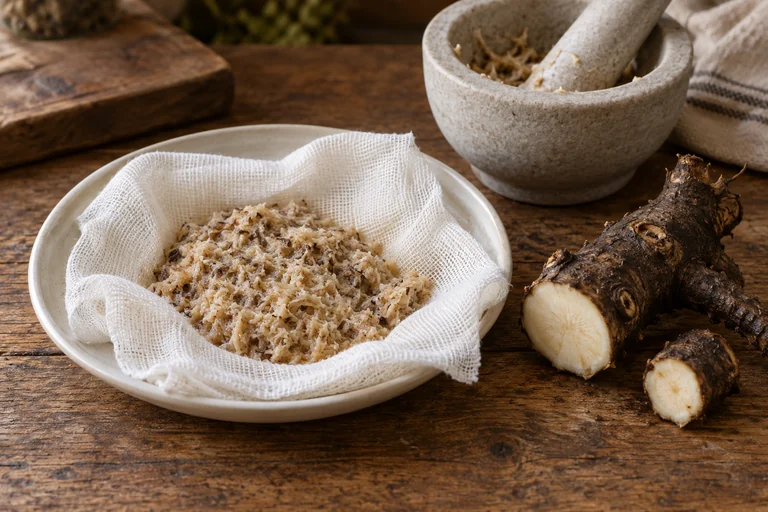
Traditional Comfrey Root Poultice
- Plant part
- root
- Duration
- 20 to 30 minutes
Ingredients
- Fresh or dried comfrey root
- A little warm water
- A clean cloth or compress
Preparation
- Wash fresh root; if using dried root, soak it in warm water until pliable.
- Grate or finely grind the root.
- Mix with a little warm water to obtain a paste-like consistency.
- Spread the paste onto a clean cloth or compress.
- Apply the poultice to the affected area, on intact skin only.
- Cover with another cloth if needed and leave in place for 20 to 30 minutes.
Sources and references
- Grieve M. A Modern Herbal. Comfrey (Symphytum officinale), 1931. Names, root description, historical root and leaf poultices, and quotations from Culpeper. Historical testimony, not a current recommendation to apply comfrey to wounds.
- Lloyd AL, Springer O. Etymologisches Wörterbuch des Althochdeutschen, vol. I, column 520, 1988. Entry beinwella: medieval names, bone/limb and healing etymology, and Consolida/Symphytum.
- EMA/HMPC. Assessment report on Symphytum officinale L., radix. EMA/HMPC/572844/2009, 2015, sections 1.1 and 2, pp. 3 and 10–11: historical uses of roots and other plant parts for injuries, fractures and ulcers. These historical uses must be distinguished from the current restricted indication for minor sprains and bruises on intact skin.
- George. Best Ways to Prepare Comfrey Poultices at Home. Reality Pathing, July 11, 2025. Section 3: Comfrey Root Poultice, and Application Tips. Fresh or dried root; rehydrate dried root until pliable, grate or finely grind, mix with a little warm water, spread on cloth and apply for 20–30 minutes. The published recipe specifies no fixed root quantity and restricts application to intact skin.