Black Pepper
Other plantsThe Price of Rome
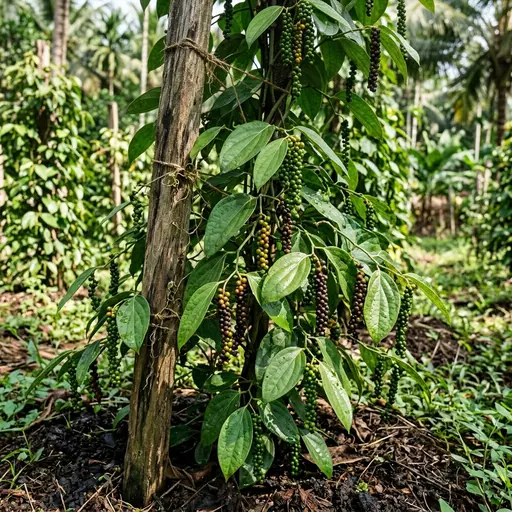
In 408, the Visigoth king Alaric besieged Rome and demanded a considerable ransom to spare the city: gold, silver, silk garments… and 3,000 pounds of pepper.
The historian Zosimus recorded this episode at the beginning of the sixth century. The presence of pepper alongside precious metals shows how highly sought-after this spice imported from India had become in the Roman world.
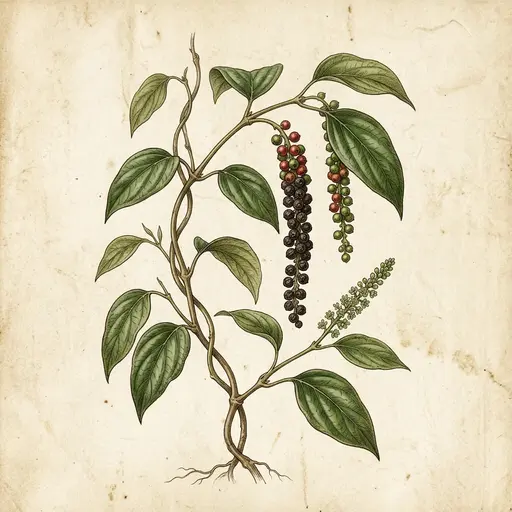
Medicinal properties
Fruits
Black pepper is traditionally associated with digestion. Its pungent flavor and main alkaloid, piperine, notably stimulate certain digestive enzymes and partly explain its traditional use for difficult digestion and gastrointestinal disorders.
Fruits
Piperine also has a particular property: it can alter the absorption and metabolism of certain substances taken at the same time. This characteristic partly explains why black pepper appears in many traditional Indian medicinal preparations.
Recipe
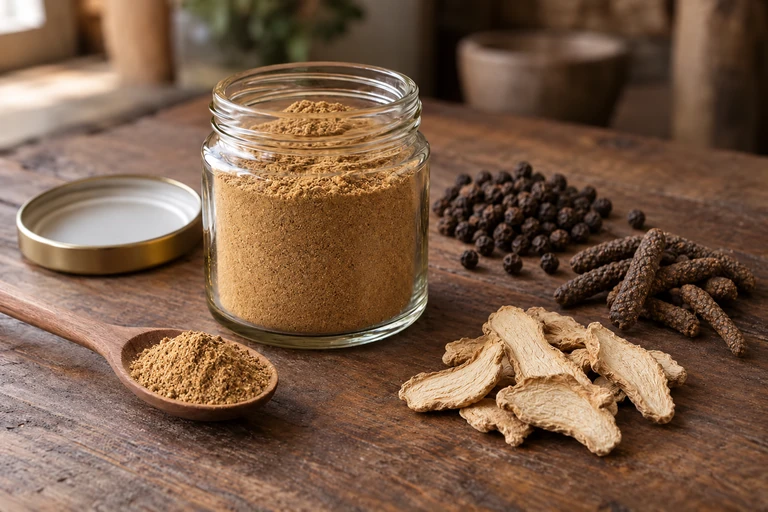
Trikatu
- Plant part
- fruits and rhizome
- Duration
- immediate
Ingredients
- 1 part ground black pepper
- 1 part ground long pepper
- 1 part ground dried ginger
Preparation
- Finely grind each ingredient if it is not already ground.
- Combine equal quantities of black pepper, long pepper and dried ginger.
- Mix thoroughly until the powder is uniform.
- Store the preparation in a dry, tightly closed container.
- To consume it, mix a small amount of the powder with honey or warm water, then swallow.
Sources and references
- Zosimus. New History. Book V, 41. Early sixth century.
- Srinivasan K. Black pepper and its pungent principle-piperine: a review of diverse physiological effects. Critical Reviews in Food Science and Nutrition. 2007;47(8):735–748. doi:10.1080/10408390601062054.
- Johri RK, Zutshi U. An Ayurvedic formulation ‘Trikatu’ and its constituents. Journal of Ethnopharmacology. 1992;37(2):85–91. doi:10.1016/0378-8741(92)90067-2.