White Willow
Other plantsGuanyin's Sacred Willow Branch
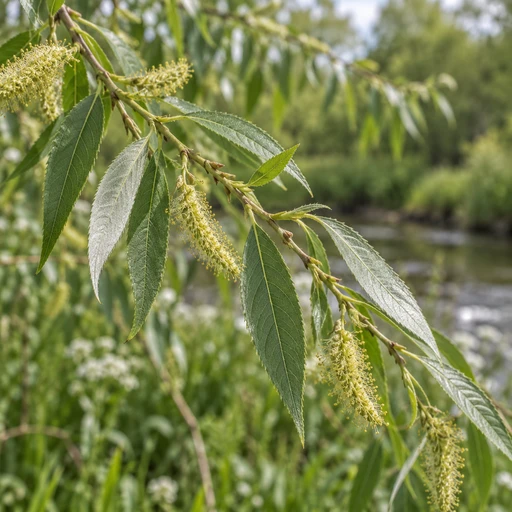
In the Chinese Buddhist tradition, Guanyin, a figure of compassion and mercy, is often depicted holding a vase of sacred water and a willow branch.
According to tradition, Guanyin dips the branch into this benevolent water and sprinkles it over suffering beings to bring healing, purification and protection.
Willow has a special meaning: its flexible branches bend in the wind without breaking, symbolising the ability to adapt to hardship with compassion.
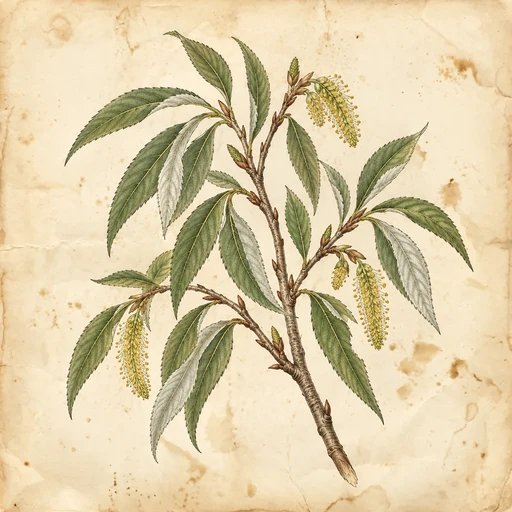
Medicinal properties
Bark of young branches
Analgesic: traditionally used to relieve mild pain, including headaches, muscle pain and back pain. Salicin in the bark contributes to its analgesic activity.
Bark of young branches
Anti-inflammatory: traditionally used for joint pain and inflammation, particularly rheumatic complaints. Its salicylate and polyphenolic compounds contribute to its anti-inflammatory activity.
Bark of young branches
Fever reducer: traditionally used to help reduce fever during febrile illnesses. This property is associated notably with salicin, which is converted into salicylic acid in the body.
Recipe
White Willow Bark Decoction
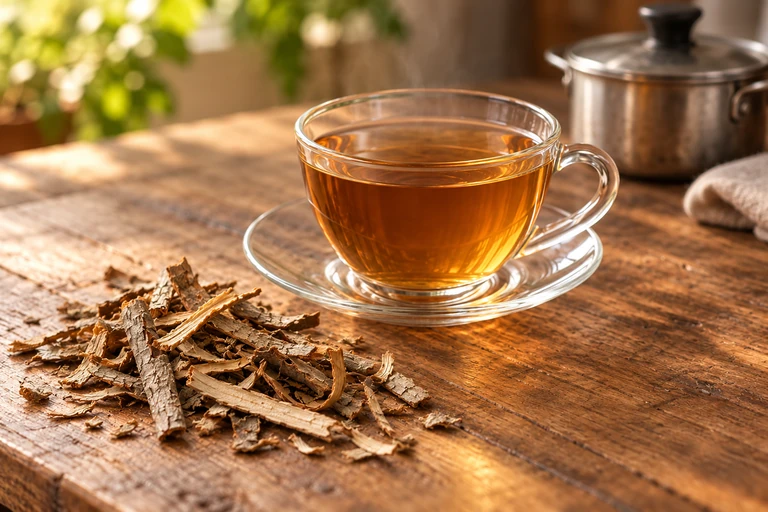
- Plant part
- dried bark of young branches
- Duration
- 15 to 20 minutes of simmering, followed by 10 minutes of resting
Ingredients
- 4 to 6 g dried, cut white willow bark
- 500 ml water
- One small saucepan with a lid
- One fine sieve
Preparation
- Use correctly identified white willow bark from young branches, thoroughly dried.
- Cut or coarsely crush the bark into small pieces to help extract its constituents.
- Place 4 to 6 g of dried bark in a small saucepan and add 500 ml of cold water.
- Bring gently to a boil, then reduce the heat.
- Cover and simmer gently for 15 to 20 minutes.
- Remove from the heat and leave to rest for another 10 minutes, still covered.
- Carefully strain the decoction to remove the bark pieces. The preparation has a bitter, slightly astringent taste.
Sources and references
- British Museum. Avalokiteśvara with willow branch and vase. Chinese painting, Tang dynasty, circa 851–900. Museum number 1919,0101,0.13.
- University of Michigan Museum of Art. Bodhisattva Avalokitesvara (Chinese, Guanyin) with a willow branch and vase. Object 1964/2.20. Willow symbolism and sacred water.
- German Commission E. Salicis cortex (Weidenrinde). Bundesanzeiger, December 5, 1984. Reproduced by Komitee Forschung Naturmedizin e. V.
- Herbal Remedies, Healthy Life. White Willow Bark for Pain Relief. July 28, 2015. Example of cold-water decoction; this card adapts the method, using different quantities and simmering/resting times from the original.
- European Medicines Agency. Salicis cortex — Willow bark. European Union herbal monograph, EMA/HMPC/80630/2016. Covers several Salix species and does not validate this specific homemade Salix alba decoction.