Burdock
Other plantsThe Plant That Inspired Velcro
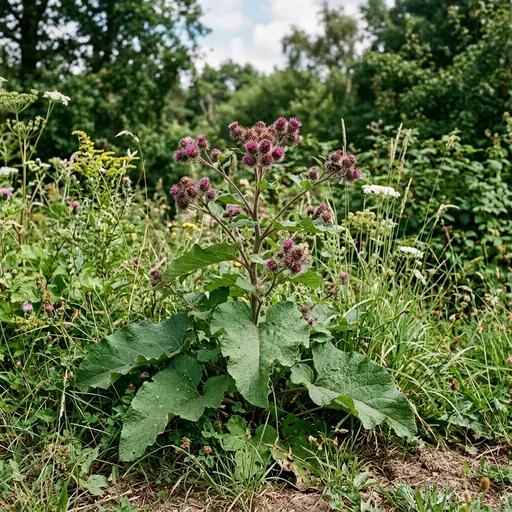
In 1941, Swiss engineer George de Mestral noticed burdock burrs clinging to his trousers and his dog’s fur after a walk. Curious, he examined them under a microscope and discovered their tiny hooks. This natural structure inspired a fastening system made of hooks and loops: Velcro. A plant often considered a nuisance had inspired an invention that would eventually be used around the world.
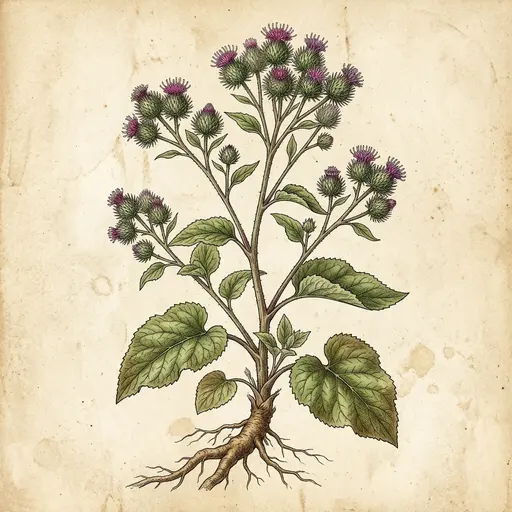
Medicinal properties
Root
Traditionally used as a mild diuretic to support urinary elimination and help flush the urinary tract during minor temporary discomfort.
Root
In herbal traditions, it is associated with the skin and elimination pathways, especially to accompany seborrhoeic skin tendencies or some long-standing skin discomforts.
Root
Its mildly bitter root is also traditionally used to support appetite and accompany slow digestion, especially as a decoction.
Recipe
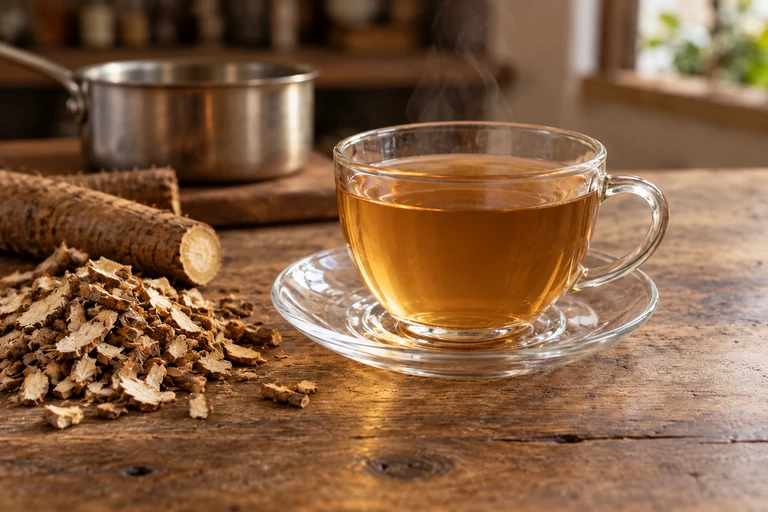
Burdock Root Decoction
- Plant part
- root
- Duration
- 10 to 15 minutes
Ingredients
- 2 to 3 g dried cut burdock root
- 250 ml water
- 1 tsp honey or a squeeze of lemon, optional
Preparation
- Place the burdock root in a small saucepan with cold water.
- Bring gently to a simmer.
- Let simmer covered for 10 to 15 minutes.
- Remove from heat and let rest for 5 minutes.
- Strain carefully, then drink warm.
Sources and references
- Kennedy, Lesley. Who Invented Velcro? HISTORY, 2 May 2025, updated 1 September 2026. De Mestral’s 1941 observation of burdock burrs on his trousers and dog, microscopic hooks and the invention of hook-and-loop fastening.
- European Medicines Agency, HMPC. Assessment report on Arctium lappa L., radix. EMA/HMPC/246764/2009, 16 September 2010, pp. 10–14 and 25. Traditional urinary elimination, seborrhoeic and other skin complaints, gastrointestinal complaints and loss of appetite. Historical uses described in the assessment are distinct from demonstrated clinical efficacy.